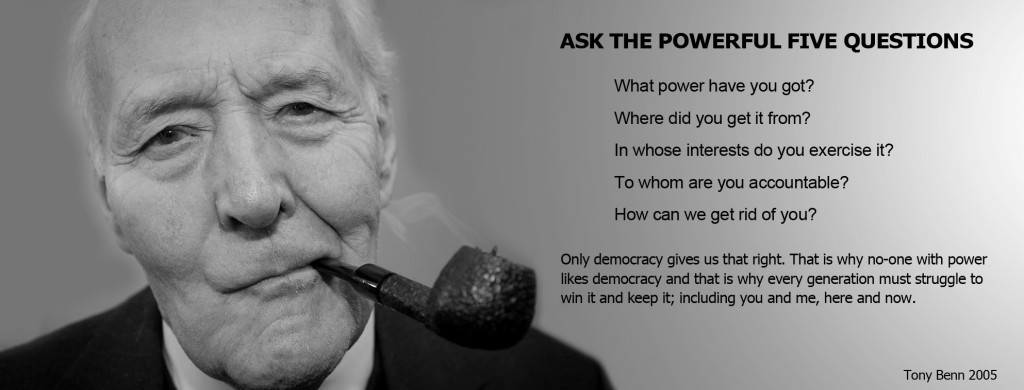
Tony Benn was a long-serving Labour Member of Parliament – totalling 47 years between 1950 and 2001 – Cabinet Minister in the Harold Wilson and James Callaghan Governments of the 1960s and 1970s, and leader of the left in Britain in the late 1970s and early 1980s. Tony Benn arguably had a positive impact upon politics, in Britain and elsewhere, in many different ways.
Regarding his impact upon the Labour Party, his ministerial experience in the 1970s pushed him to the left – an unusual trajectory given that most people shift to the right when they gain access to power – and this radicalization encouraged him to pursue both institutional and policy change. Institutionally, Tony Benn successfully campaigned for the democratization of the party and these changes included the creation of an electoral college to choose the Party Leader – previously the preserve of the Parliamentary Labour Party; the right of the National Executive Committee to help draft the party’s manifesto – previously the preserve of the Party Leader; and the right of party members to select and deselect their MP/prospective candidate – thus ending the notion that a Parliamentary seat was a ‘job for life’ and making MPs more accountable to their constituencies. Police-wise, Tony Benn successfully campaigned for a raft of radical policy measures that, had they been implemented, would arguably have led to a ‘fundamental and irreversible shift in power and wealth’. These measures included nuclear disarmament, withdrawal from the European Community and NATO, the nationalization of key sectors of the economy, workers’ control, a massive house-building programme, a wealth tax, etc. To his detractors, Tony Benn helped to make the Labour Party ‘unelectable’ and left it in the wilderness of opposition for 18 years. This charge begs two important questions however: what is the purpose of social democratic parties like the Labour Party if it is not to bring about radical change in favour of working people? And if we must be governed by a political elite then should it not lead and make the case for radical change rather than pander to the minority of ‘swing’ voters, triangulate and attempt to assuage the right-wing media? Furthermore, once we dispatch with lazy slogans such as ‘the loony left’ – Tony Benn was regularly described by right-wing newspapers as ‘the most dangerous man in Britain’ – then we can begin to have a proper debate about important issues such as equality, economic democracy, nuclear weapons, self-government, etc. As Tony Benn repeatedly pointed out, most of the electorate is well to the left of the narrow consensus that is defined and defended by the media and the two- (now three-) party political system. So who could and should articulate the interests of the majority: a radicalized Labour Party or a new workers’ party? This debate has raged for a long time and continues to do so. Furthermore, it is often forgotten that Tony Benn was instrumental in helping the party to embrace the new television age of the 1960s and to improve its political communications accordingly; for Tony Benn, policy presentation was just as important as policy content.
Regarding his impact upon politics more generally, Tony Benn and the social forces that he championed can be located in Britain’s long history of radical dissent. This can be traced back to the Peasants’ Revolt of 1381 and is manifest in the struggles of the Diggers and Levellers during the English Revolution; the formation of the trade union movement and Labour Party; and the campaigns organized by the Chartists, the Suffragettes, the anti-nuclear movement, the anti-Apartheid movement, Black Power, Women’s Liberation, Gay Liberation, the anti-globalization movement, the Stop the War movement, the anti-cuts movement, the People’s Assembly, etc. Indeed, not only was Tony Benn conscious of Britain’s radical past but he positively celebrated it (see his Big Ideas That Changed the World: Democracy at http://www.youtube.com/watch?v=rokTiJfL4WY). Tony Benn also made a practical contribution: making constitutional history by rejecting his peerage in 1963.
Regarding his impact upon political science, Tony Benn was meticulous in recording his experiences and thoughts as an activist, MP and Cabinet Minister. These political diaries, which span several decades, provide an illuminating insight into the realities of liberal democracy, the British Parliamentary system and the politics of the labour movement. They will be mined by political scientists and others for many years to come. His revelations about the power and role of the media, the so-called ‘permanent state’ (i.e. Civil Service) and the ‘secret state’ (i.e. intelligence agencies) are particularly startling and they offer a useful guide to all progressive forces seeking to transform Britain. Tony Benn also opened his personal archive to academics and students alike.
On a personal note, as an anarchist I took issue with Tony Benn’s faith in the Parliamentary road to socialism; as Emma Goldman allegedly said: ‘if voting changed anything they would make it illegal’. Nevertheless, viewed as reformist staging posts on the way to a social revolution, most of the policies that Tony Benn spent his life campaigning for are ones which I could support. Indeed, I still do. As a PhD student, I was privileged to have been granted an interview with Tony Benn in April 2005 and he very kindly provided the Foreword to my first book entitled The British Left’s ‘Great Debate’ on Europe. Tony Benn is one of the reasons why I chose to become an academic and I must admit that I became a bit of a Tony Benn ‘fan club groupie’, always taking the opportunity to hear him speak in person at lectures and rallies, particularly after he departed the House of Commons in 2001 to ‘devote more time to politics’. Like many others, I found him compelling and inspirational.
Tony Benn once said that ‘the people who are remembered are the teachers. Many people go through life with a little torch illuminating their feet, but the teacher sends up a pyrotechnic which, just for a second, illuminates the whole landscape’. Tony Benn was such a teacher and he profoundly influenced my intellectual and political development. In short, he encouraged me.
RIP Tony Benn. You are already missed.
Dr Andy Mullen
Senior Lecturer in Politics, Department of Social Sciences
